
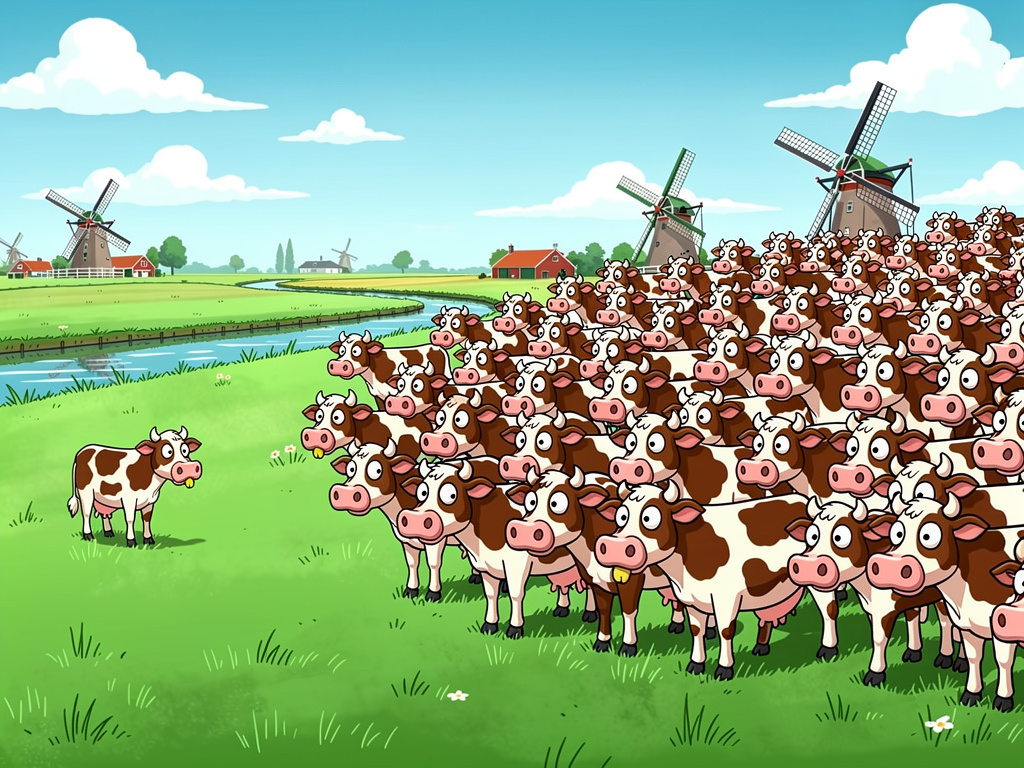
 The Netherlands likes to feign surprise. We pretend that the nitrogen crisis fell from the sky in 2019, somewhere between a ruling by the Council of State and the first tractor convoy on the A1. But anyone who digs into the archives finds something more uncomfortable. This problem was already ready when our grandparents were still living on the receipt. It's been eight decades waiting for someone to make the bill, and now that bill, with interest, is just on the table. This is the story of how a country that once had to send its cows away to plant potatoes became one of the most animal-tight places on earth, and why no one is blamed for it on their own.
Butter, Cheese and a World War
We start in the 1940s, and not because it happens to be a round number. During the Second World War, the Dutch government ordered farmers to reduce their livestock, so that more land remained for potatoes and grain. The National Office for Food Supplies in Wartime directed that switch, with additional food vouchers as a consolation prize for the farmer who had to hand in his cows. It's a curious thing to open with, because it shows that a shrinking herd was once quite normal, and even policy.
From scarcity to abundance was then a matter of decades, not centuries. The 1950s and 1960s brought reconstruction, mechanization and an unspoken promise, namely that growth was by definition progress. Towards the end of the 1960s, the first scientific publications on manure surpluses appeared, with dry titles such as Manure surpluses, a potential source of environmental pollution from 1970. No one read them at the kitchen table, but the clock was ticking.
We didn't punish the cow for giving too much, we rewarded her with a neighbor, and then another, and then another.
The 1970s warned.
Then the seventies, the decade in which the first official paperwork appeared that you can hardly call a surprise. The Urgentienota Milieuhygiëne from 1972, drawn up by the brand new Ministry of Housing and Environmental Hygiene, acknowledged in black and white that there were local manure surpluses and that further growth of the herd was undesirable from an environmental point of view. The ministry did put its hopes on technical gadgets and manure banks, something that sounds a bit like hoping that a bucket with a hole will just get used to it.
Farmers themselves were warned of an impending manure crisis in those same years, according to later retrospectives. CBS later concluded that mineral surpluses continued to rise until 1986 due to the intensification of agriculture, while the first concrete policy measures did not come until 1984. So there was a gap between the signal and the action for more than a decade, and that gap would be much bigger. It is the pattern that you continue to recognize throughout this story, namely that knowledge and policy were never equal.
Science whispered, politics put pussies in her ears, and the farmer just had to milk.
'80s and '90s, the evidence is piling up
In the 1980s, ammonia was finally mentioned by name as a serious environmental problem, and that's not a bad thing for a gas that you don't smell unless you're in the middle of it. Journals as Farm and Livestock farming already wrote about the need to reduce emissions, and RIVM pointed out harmful effects of nitrogen deposition on nature reserves. The 1990s followed with real instruments instead of good intentions. The European Nitrates Directive of 1991 required Member States to deal with pollution by nitrates, the Fertilizers Act was tightened, and in 1998 came the Minerals Declaration System, or MINAS for short, in which companies with too much mineral surplus were simply billed.
Some farmers invested in low-emission stables and injection techniques for manure, others felt, not entirely unjustifiably, for the umpteenth time as guinea pigs from a system they had not designed. The table below shows how livestock per inhabitant continued to grow steadily in those years, even after the first alarm bells had already sounded.
| Decade | Farm animals per inhabitant (indication) | Share of land area for livestock farming | Share of GDP from agriculture |
|---|---|---|---|
| 1950 | approximately 2.7 | unknown | approximately 14% |
| 1960 | approximately 4.2 | unknown | declining trend |
| 1970 | approximately 5.0 | unknown | declining trend |
| 1980 | approximately 6.7 | approximately 29% | descending towards 5 to 8% |
| 1990 | approximately 7.4 | approximately 30% | declining trend |
| 2000 | approximately 7.6 | approximately 30% | approximately 2.8% |
What stands out is the contradiction in those figures. The economic weight of agriculture in the Netherlands declined steadily, from 14 percent of GDP in 1950 to less than three percent around the turn of the century, while the physical number of animals continued to rise. The farmer thus became, in an economic sense, less and less important for the Netherlands as a whole, and at the same time had to produce more and more to keep his head above water. That's not a recipe for rest, that's a recipe for a system that has to run itself harder and harder to stay in the same place.
More cows for less money, that's not growth, that's running on a treadmill someone else has set up.
Who was actually at the wheel?
It's getting uncomfortable here, and rightly so. The large livestock population is the direct cause of the nitrogen emissions that are now putting pressure on Natura 2000 sites, that is undeniable. But the farmer who molked these cows was rarely the architect of this system. Banks that financed and rewarded economies of scale, as Rabobank did for decades, gave the signal that bigger was always better. Governments postponed painful choices, from 1972 to well into the 1990s, and allowed technical lapping agents to continue for structural solutions. And the burger, the ordinary Dutchman in the supermarket, chose week after week for the cheapest package of milk and the cheapest piece of meat, without considering that this low price was only possible due to exactly the intensification that is now being punished so hard.
So the farmer was stuck between a bank that encouraged growth, a government that intervened too late, and a consumer who let his wallet speak. That does not make the farmer an innocent bystander, but a person who has also become a victim of a system of which he himself has never set the rules.
No one asked the farmer to be guilty, everyone just asked him to deliver.
For now
In the last twenty years we all know, with the PAS, the ruling of the Council of State in 2019 and the tractors on the Malieveld. That bill didn't come out of nowhere, it was just postponed for a long time. It is like a debt that you accumulate for years, occasionally skips a repayment and thinks it will be okay later, until one day the bailiff asks for everything back in one go.
Research, of myself and of many others who have been following this dossier for decades, shows that we all find it important, but that we do little in the meantime. That feeling that something has to be done, that finally deserves action, not another report.
We knew it in 1972, we knew it in 1991, and now we're pretending it's news.
Sources
- National Office for Food Supplies in Wartime, Wikipedia
- Historians.nl, dossier Ecohistory, environmental policy in historical perspective
- Overland.nl, about the Urgentienota Environmental Hygiene 1972
- HBP Media, Farmers have been warned of manure crisis since the 1970s
- NOS, The nitrogen problem is really Dutch, explained in eight graphs
- NRC, The Nitrogen Crisis Explained
- Vistikhetmaar.nl, The nitrogen problem in the Netherlands
- Milieudefensie Jong, The nitrogen crisis, how the farmers got stuck
- De Telegraaf, Nitrogen crisis is not about nitrogen
- Party for the Animals, contribution Wassenberg on manure policy
- PBL, Nitrogen and nature approach in the Netherlands
- Wikipedia, Manure surplus in the Netherlands
- Wikipedia, Mineral accounting
- CBS, Animal manure, production, transport and use, key figures 1950 to 2013 (StatLine 80408NED)
- CBS/Compendium for the Environment, Development of livestock on farms, 1980 to 2024
- CBS, Grassland, area and yield
- CBS, Agriculture in the Dutch economy (longread)
- CBS, Production value of agriculture and horticulture, 1995 to 2015 (CLO)
- Wageningen Economic Research / WUR, various publications on grassland and agricultural area
- CPB, The Dutch economy in historical perspective
 English (UK)